The simple answer is no. As indicated in the article below, since drivers under the age of 18 must take drivers ed., they receive better training than those over the age of 18 who do not have to take drivers ed.
An additional reason teens are waiting to get their licenses is that they no longer have to be together to socialize as a result of social media. In fact, most teens can be in the same room and continue to interact using social media rather than face to face interaction. Please read the article below for more information.
For years, a driver’s license represented to teenagers
tantalizing adult freedoms. That little piece of plastic inspired
visions of sun-kissed road trips, sports cars and make-out sessions in
parking lots where mom wouldn’t drop in.
But for Washington teens, a subtle shift is under way. More are waiting to get licensed.
To
nervous parents, it might sound appealing to put off sleepless nights
worrying about car crashes. But to the Department of Licensing, the
trend is troubling because it means more new 18- to 21-year-old drivers
are hitting the pavement.
“Those are some of the riskiest drivers on the road,”
said Department of Licensing Special Projects Manager Brady Horenstein —
even riskier than 16- to 17-year-olds who, counterintuitively, make
better drivers.
A look at who receives learners’ permits indicates the trend.
A comparison of 10 years of the licensing department’s permit data
and Census Bureau population estimates shows the number of teens 15 to
17 who have permits has fallen slightly since 2004. Meanwhile, the
number of 18- to 21-year-olds permitted has risen nearly 47 percent
statewide during the same period. Without a permit, teens 17 and
younger can’t get a license.
The trend is most evident in poorer communities, where fewer people
seek permits. In ZIP codes with lower median incomes, a higher
percentage of teens wait to pursue licenses until after they turn 18.
Why teens wait
In 2012, the AAA Foundation for Traffic Safety surveyed more than 1,000 18- to 20-year-olds across the nation who didn’t get their licenses until after they turned 18.
Why delay, the foundation asked?
Forty-four percent who responded said they didn’t have a car (so
what’s the point?), 39 percent said they could get around just fine
without driving and 36 percent said the cost of driving or gas was too
expensive. (The numbers add up to more than 100 percent because those
surveyed could list more than one reason.)
The cost of driver’s education played a role, too: 28 percent cited
driver’s ed courses as a reason they didn’t get licensed; 26 percent
said driver’s ed was too expensive.
In the past, driver’s ed was offered through public schools, but the
Legislature in 2002 largely stopped subsidizing driving instruction. In
2012, Seattle Public Schools stopped offering driver’s ed programs altogether. By 2013, 88 percent of Washington driving students took classes at private driver’s ed schools.
In Washington, driver’s education usually costs about $500, and until
you’re 18, classes are required to get a license. Janet Ray, of AAA
Washington, said some frugal or financially unable teens simply wait
until they’re 18, so they don’t have to pay for class.
Others just don’t seem to care. Thirty-five percent of teens who
responded to the AAA survey said they “just didn’t get around to it.”
A license might be a ticket to freedom, but the cost is too steep for some and not worth it for others.
Tran Lam, 18, said her family wasn’t in a position to pay for driving lessons.
“I wanted to do driver’s ed, but the thing is, the classes cost $400
to $500 and based on our family’s financial situation back then, I
couldn’t do it,” she said.
Lam plans to attend the UW next spring. She’s saving for a car and
hopes to get her license but said saving for college is more important.
“I didn’t think I would need a car for anything. I could take the bus
around or walk,” she said. “But I’m a senior now and I have a job and I
have to run errands. Living without a car is really hard —
complicated.”
Kaloni Sadettanh, 16, said his dad has been teaching him to
drive (“I’m already pretty good at it”). Still, the Cleveland student
said he wanted to “get the fundamentals” at driver’s ed. Sadettanh, who
takes Metro buses, bikes and walks wherever he needs to go, said his dad
would probably help pay for driver’s ed if he kept his grades up, but
he didn’t feel like he needed a car to impress anybody at school.
“High school’s about fitting in, but you don’t have to have a car to say, ‘Look at me,’” he said.
To Sadettanh, a car represents not adolescent freedom, but something
mundane: “You’re maturing,” he said. “I see it as a privilege.”
Jamilette Ruiz, 19, said her dad bought her a 2002 Mini Cooper, but
it’s been sitting in the driveway. She just never got around to getting
her license.
“It was not one of my priorities,” she said. She takes the bus and her older siblings give her rides.
Ruiz said if she’s 25 and still doesn’t know how to drive, she’ll need to do some “getting my life together.”
‘Riskiest drivers on the road’
The problem with teens waiting to get licensed: Those who wait become worse drivers, statistically, at least.
Recent licensing-department citation data shows drivers who got their
licenses at age 18 received, on average, about three times as many
citations as people who began driving at 16. Drivers over 18 are more
likely to fail their driving tests.
To become licensed before turning 18, drivers must get a permit to
practice and take driver’s ed. Once they turn 18, they simply have to
pass the knowledge and in-person driving tests.
Conceivably, someone could pass both tests without ever having driven on a highway. The state driving test doesn’t cover that.
Horenstein said restrictions on licensed drivers under 18 help keep
them safe. Those 16 to 17 years old receive an intermediate license
— they can’t have passengers under the age of 20 for the first six
months, and can’t drive between 1 a.m. and 5 a.m. for the first year,
unless they turn 18.
“There are no restrictions at all on an 18-year-old,” said
Horenstein. “Passenger restrictions, nighttime restrictions — study
after study has shown those produce better public-safety outcomes.”
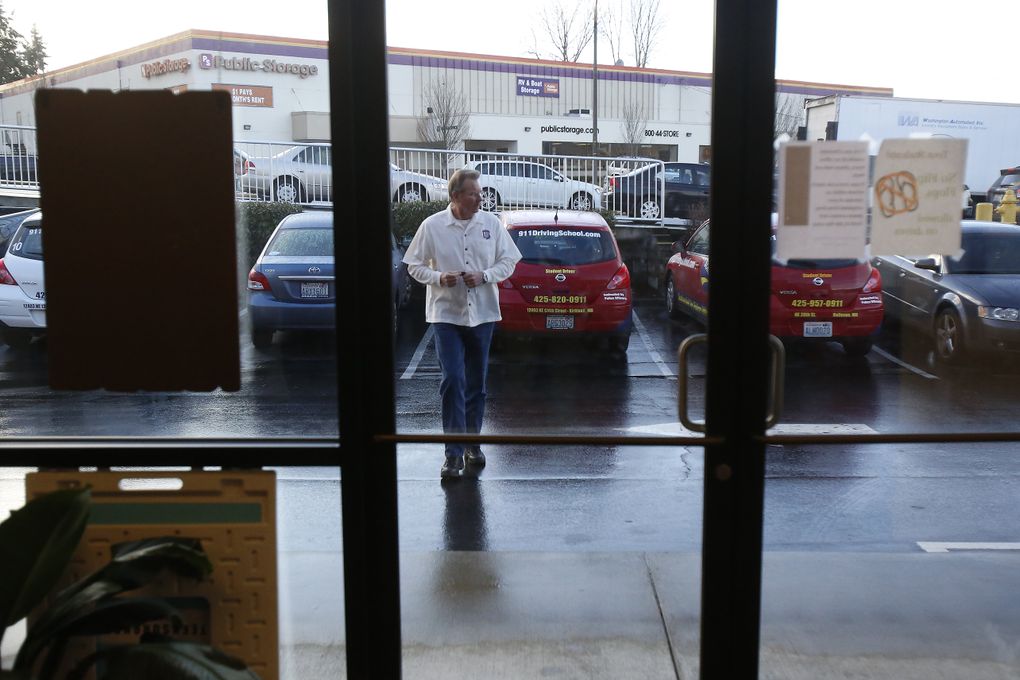
Instructor Steve Phelan walks into 9-1-1 Driving School before he gives driving lessons. (Sy Bean / The Seattle Times)
Education matters
Teens who take driver’s ed fare much better on the road. A Nebraska study
that followed 150,000 drivers over eight years found those who never
took class were 24 percent more likely to be involved in a fatal wreck.
At 9-1-1 Driving School in Kirkland, former Bothell police Officer
Steve Phelan makes a convincing co-pilot. A lean man with short-cropped
hair and a neatly trimmed mustache, Phelan wouldn’t be out of place in a
“Top Gun” remake.
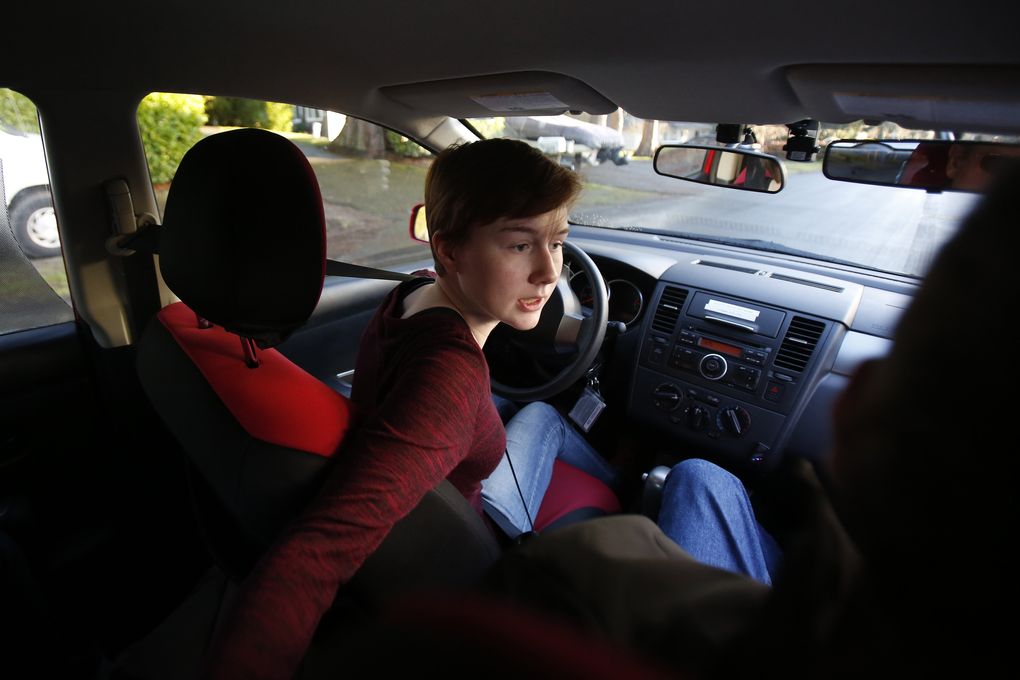
Not that 15-year-old Paige Henderson, on her third drive for class at
the school’s Kirkland location, needed a co-pilot. Phelan tapped the
brakes just once from the passenger seat during Henderson’s lesson.
She’s a capable driver who narrated her time behind the wheel in a witty
singsong voice.
Henderson didn’t flinch when a Volkswagen cut her off (“My mom says
you’ve always got to anticipate other drivers are stupid,” she said), or
when a car crept into her lane (“Hello there, friend!”), or when a
little girl walking from school let out a bloodcurdling scream for no
obvious reason (“Me too, kid. Me, too.”).
Paige
Henderson, 15, practices parallel parking during a driving lesson with
9-1-1 Driving School in Kirkland. State data shows that younger drivers
in Washington receive fewer traffic citations than those 18 and older.
The driver’s ed requirement and restrictions on new drivers under 18
might be part of the reason. (Sy Bean / The Seattle Times)
But she’d never parallel parked. Phelan directed her to the side of an SUV.
“Don’t you have cones or something set up?” asked Henderson nervously.
“No, we’ve got to have live cars. Makes it more interesting,” Phelan said coyly.
Phelan briefly explained proper technique and then let Henderson give it a try.
“So, you’re going to put it into reverse, turn all the way to the right … ”
Henderson carefully guided the Nissan Versa to a 45-degree angle to the curb and pulled in behind the SUV.
“Sweet. That was way easier than I was expecting,” the relieved Woodinville High School sophomore said.
Henderson is one of those kids with a life-plan already mapped out.
She’s going to keep up her 4.0 GPA and plans to get a zoology or biology
degree in college.
And she has a few advantages on her path to becoming a safe driver.
“Her parents are involved in her driving. That makes a huge difference,” Phelan said.
Her family was also willing and able to pay for driving school.
“It’s been forever since I learned to drive. I don’t want to pass on any bad habits,” Mark Henderson, Paige’s father, explained.
A motivated student, involved parents and driving-school education
right away — that’s the right recipe, said Jack Scott, who owns
Kirkland’s 9-1-1 Driving School. But he realizes that’s not possible for
everyone.
“The cost of driving schools are anywhere from $500 to get the course
completed. That could be an essential amount of money for people,”
Scott said.
Lawmakers
At the governor’s behest, the DOL has been working with
lawmakers to create a driver’s ed class designed for the 18- to
21-year-olds who haven’t become licensed.
Senators this session introduced a bill
that would require those drivers to take up to 10 hours of classes,
including three hours of practical driving lessons. Low-income
prospective drivers would be able to apply for subsidies.
But the bill fizzled in the Senate and failed to get out of committee.
For Henderson, it’s concerning that some of her older peers might not be trained.
“There’s stuff they don’t cover (in written tests) on the practical
drives,” she said. “People on the road should have to take the class or
have certified education.”
Great blog about PJC (Prayer for Judgment Continued)
Thanks to the NC SOG for the post. A lot of people misuse the PJC and think its uses are unlimited as is their number.
Judges can continue prayer for judgment in any case. Except when they can’t.
In North Carolina, when a defendant is convicted, either after a
trial or by guilty plea, the court is generally viewed as having the
authority to continue prayer for judgment in the case. A prayer for
judgment continued (PJC) can serve different purposes. It can be a mere
continuance of sentencing in the case, allowing the court to obtain
additional information about the defendant before entering judgment. It
can take on the character of a suspended sentence, with the PJC set to
continue “from term to term” for some specified period on condition of
the defendant’s good behavior, with the understanding that the State
will pray judgment and the court will sentence the defendant in response
to any reported misconduct. Often, however, it is everyone’s
understanding that a PJC will be the last thing that happens in a
case—an exercise of judicial mercy that will leave the defendant with a
conviction but no punishment for it. I sometimes refer to that last type
of PJC as a dispositional PJC. Practice on all types of PJCs varies
across the State.
The precise legal underpinnings of the dispositional PJC are hard to pinpoint. I walked through some of the history of PJCs in this post, noting that the modern appellate courts generally approve of a trial judge’s broad authority to continue prayer for judgment. See State
v. Van Trusell, 170 N.C. App. 33 (2005) (“North Carolina courts have
the power to continue prayer for judgment . . . .”). If you look
carefully at the cases cited in support of that authority, they are
mostly talking about a probation-like, term-to-term type of PJC. But
suffice it to say that at this point, the baseline rule is that a judge
can continue prayer for judgment in any case unless some legal authority
says otherwise.
There are a small number of legal authorities that say otherwise.
In a few circumstances, PJCs are prohibited by statute.
Under G.S. 20-141(p), a driver charged with speeding in excess of 25 miles per hour shall be ineligible for a PJC.
Under G.S. 14-205.1(a),
any defendant who solicits another for prostitution—be it a first
offense, a second or subsequent offense, an offense against a minor, or
an offense against a severely or profoundly mentally disabled
person—shall not be eligible for a PJC under any circumstances.
Under G.S. 20-217(e), a defendant who passes a stopped school bus shall not receive a PJC under any circumstances.
In one important circumstance, a dispositional PJC is prohibited by case law. As Shea discusses in The Law of Impaired Driving and Related Implied Consent Offenses in North Carolina
(p. 145–46), our the appellate courts have interpreted the sentencing
provisions for impaired driving in G.S. 20-179 to be a “mandatory”
sentencing regime that prohibits dispositional PJCs in DWI cases. In re
Greene, 297 N.C. 305 (1979) (“We hold that the Courts at North Carolina
do not have an ‘inherent’ power to continue prayer for judgment on
conditions or to suspend sentence where the sentence is made mandatory
by the General Assembly.”). Now, one could argue that all of North
Carolina’s sentencing laws, not just G.S. 20-179, are “mandatory,” but
cases like Van Trusell show that the Greene rule has been limited to impaired driving.
In 2012, the General Assembly enacted a final statutory limit on PJCs in G.S. 15A-1331.2.
Under that law, the court shall not dispose of any Class B1–E felony by
ordering a PJC that exceeds 12 months. Any PJC ordered in those cases
must include as a condition that the State shall pray judgment within
some specific time not to exceed 12 months. Once that time has expired,
the court must enter a final judgment, unless it finds that it is in the
interest of justice to continue the order for some additional time not
to exceed 12 more months. The court may not extend the PJC beyond that
one additional 12-month period.
This relatively new rule obviously precludes a dispositional PJC for
any serious felony. That’s not something you hear about very often in
any event, but it used to happen from time to time.
The parties should also be aware of this requirement when a defendant
in a serious felony case is granted a PJC to allow him or her time to
demonstrate good behavior before sentencing. Sometimes 24 months will
not be long enough for the defendant to do whatever he or she agreed to
do. There is some argument that the law applies only to truly
dispositional PJCs (the statute uses the word “dispose”), and not to
mere delays in sentencing. But until we have case law interpreting the
provision, the new timeline is something you may wish to take into
account.
Raleigh is about to put several roundabouts on Hillsborough Street according to the article below. As a result, it is a good time to review how to use a roundabout.
Among the changes coming with the city’s latest renewal
project along Hillsborough Street will be three new roundabouts at
intersections that now have traffic lights.
And this weekend the traffic lights are coming down.
The city will close
several blocks of Hillsborough Street at the western end of N.C. State
University’s campus starting at 7 p.m. Friday, Feb. 23, so it can take
down four sets of traffic signals and create the new roundabout traffic
pattern. The street is expected to remain closed until 6 a.m. Monday,
Feb. 26, though it could reopen earlier, said project manager Richard
Dickie.
The new roundabouts will be constructed in the coming weeks at Brooks
Avenue, Dixie Trail/Friendly Drive and Shepherd/Rosemary streets, though
drivers will begin using the roundabout pattern now. Traffic engineers
say roundabouts slow traffic down while keeping it moving and are safer
than traditional intersections.
The traffic light at Dan Allen Drive, an entrance to the
NCSU campus, is also coming down. Traffic from westbound Hillsborough
will have a turn lane to make left turns into Dan Allen, while all
traffic exiting Dan Allen will turn right onto eastbound Hillsborough.
Dan Allen drivers wishing to go westbound on Hillsborough will be
directed to use the roundabout at Brooks Avenue to turn around.
The roundabouts are part
of a $17.5 million reconstruction project that will include buried
utility lines and new sidewalks, bike lanes, medians and street lights.
The weekend closure will allow workers to move traffic to the outside
lanes and put barriers in place so they can build the medians and
roundabouts, Dickie said.
“This marks the next
step in the evolution of Hillsborough Street,” he said. “We’ve finished
the two sides, the sidewalks are there and all the underground
improvements. We’re approaching the finish line.”
Through traffic on
Hillsborough will be directed on a detour that includes Brooks Avenue,
Wade Avenue and Faircloth Street. Restaurants, stores and other
businesses along the street will remain open during construction.
The city expects to complete the Hillsborough Street Renewal Project in May. For more information, go to hillsboroughst.raleighnc.gov/.
Quick List of things to Remember:
Slow down.
Look and plan ahead.
Pedestrians go first. When entering or exiting a roundabout, yield to pedestrians at the crosswalk.
Look to the left, yield to all traffic in the roundabout, find a safe gap, and then go.
On December 1, 2015, the law changes on Driving While License Revoked. The purpose of this new law is to eliminate the snowball affect of driving while license revoked when the revocation is not due to impaired driving.
Below is a great article from Shea Denning at the North Carolina School of Government.
The General Assembly ratified the North Carolina Drivers License Restoration Act
last week and submitted it to the Governor. If the act becomes law, it
will relieve defendants convicted of certain types of driving while
license revoked of the mandatory additional license revocation that has
historically followed such convictions. Proponents for a change in the
law argued that people convicted of driving while license revoked under
current law drove during the revocation period out of necessity and then
became locked in an unending cycle of license revocation.
The cycle developed this way: A person was convicted of an offense requiring revocation of the person’s license. You can find a chart of such convictions here.
The person drove during the initial revocation period, sometimes
because he or she had no other way to travel to and from work. The
person was stopped by a law enforcement officer and charged with driving
while revoked. Upon conviction, the person’s license was automatically
revoked for an additional year. During that additional year, the person
again was convicted of driving while license revoked. This time, the
additional revocation period was two years. The person’s third
conviction for driving while license revoked led to a permanent license
revocation. H 529 ends that cycle for some defendants, effective for convictions on or after December 1, 2015. Recodification. The legislation assigns each of the two types of driving while license revoked currently codified in G.S. 20-28(a)
to its own subsection. Driving while license revoked for impaired
driving, a Class 1 misdemeanor, is codified in amended G.S. 20-28(a1).
Driving while license revoked generally, a Class 3 misdemeanor, remains
in G.S. 20-28(a).
The punishment for driving without reclaiming a license is moved to
G.S. 20-28(a2), and the offense of driving after notification or failure
to appear is codified in new subsection (a3).
The chart below sets forth the various subsections as recodified by H 529.
G.S. 20-28(a)
Driving While License Revoked
Class 3 misdemeanor
G.S. 20-28(a1)
Driving While License Revoked for Impaired Driving
Class 1 misdemeanor
G.S. 20-28(a2)
Punishment for Driving Without Reclaiming License
Class 3 misdemeanor
G.S. 20-28(a3)
Driving After Notification or Failure to Appear
Class 1 misdemeanor
If H 529 becomes law, a person convicted of driving while license
revoked under G.S. 20-28(a) on or after December 1, 2015 will no longer
be subject to a mandatory additional period of license revocation.
Persons convicted of violating G.S. 20-28(a1) or (a3) still will be
subject to the automatic revocation periods described at the outset of
this post. Persons punished for driving without reclaiming a license
are not subject to an automatic additional revocation period under
current law or H 529.
A person’s license also is subject to automatic revocation under current G.S. 20-28.1
if the person is convicted of a motor vehicle moving offense that was
committed while the person’s license was revoked. H 529 amends G.S.
20-28.1(a) to provide that a violation of G.S. 20-7(a) (no operator’s
license), 20-24.1 (failure to appear or pay for motor vehicle offense),
or G.S. 20-28(a) or (a2) shall not be considered a motor vehicle moving
offense unless the offense occurred in a commercial motor vehicle or the
person held a commercial driver’s license at the time of the offense. Ignition interlock amendment. Not all of the
provisions of H 529 afford relief to defendants, however. The act amends
G.S. 20-17.8(f) to specify that a person subject to an ignition
interlock restriction who violates the restriction commits the offense
of driving while license revoked for impaired driving under G.S.
20-28(a1) and is subject to punishment and license revocation as
provided in that section. This is a change from what current law provides.
The act also amends G.S. 20-179.3(j)
to provide that the holder of a limited driving privilege who violates
any of its restrictions commits the offense of driving while license
revoked for impaired driving under G.S. 20-28(a1) and is subject to
punishment and license revocation as provided in that section. This is a
technical change that accounts for the recodification but does not
change treatment of limited driving privilege violations under current
law. DWI sentencing change. Finally, the act makes a corresponding change to the grossly aggravating factor in G.S. 20-179(c)(2)
that elevates the punishment for DWI when a person is driving at the
time of the offense with a license that is revoked for impaired
driving. Amended G.S. 20-179(c)(2) lists as a grossly aggravating
factor “[d]riving by the defendant at the time of the offense while his
driver’s license was revoked under G.S. 20-28(a1), and the revocation
was an impaired driving revocation under G.S. 20-28.2(a).” The last
clause is confusing. Is it surplusage since G.S. 20-28(a1) only applies
to persons whose licenses are revoked for an impaired driving revocation
or for an ignition interlock violation? Or does it operate to exclude
ignition interlock violations from the grossly aggravating factor since
they are not listed as impaired driving revocation under G.S. 20-28.2(a)? Perhaps a technical corrections bill later in the session will clear this up.
Here are some great DWI questions. Thanks to Shea Denning of the NC School of Government for her blog.
Defendant is sentenced on the same day for two DWIs. May the sentences run concurrently?
Yes. Contrary to popular belief, there is no requirement that
sentences for misdemeanor impaired driving in violation of G.S. 20-138.1
run consecutively to one another. Indeed, if the judgment does not
specify how the sentences are to be served, DWI sentences, like
Structured Sentencing sentences, run concurrently. G.S. 15A-1354(a).
Misdemeanor impaired driving convictions may not, however, be consolidated with one another for judgment. G.S. 20-179(f2).
Thus, a separate judgment must be entered for each DWI conviction. A
misdemeanor DWI conviction may be consolidated with a conviction for an
offense that carries greater punishment. Id.
Defendant is sentenced for DWI. How long may his period of probation be?
Five years. And no special findings are required to impose a sentence of that length. G.S. 15A-1342(a).
This rule differs from the length-of-probation rules that apply to
Structured Sentencing offenses, and which require special findings to
impose longer or shorter periods of punishment. Cf.15A-1343.2(d).
No particular minimum period of probation is required, but probation
imposed for a DWI must be long enough to allow the defendant to satisfy
the minimum requirements for a suspended DWI sentence.
Defendant is sentenced for Level A1 DWI. His sentence is
suspended on condition that he serve 120 days imprisonment and that he
abstain from alcohol for 120 days as monitored by a continuous alcohol
monitoring system. May the defendant serve the 120 days on weekends?
Yes. A period of imprisonment imposed as a condition of “special
probation” for any criminal offense may be served in nonconsecutive
periods, such as on weekends. G.S. 15A-1351(a).
While all special probation confinement for Structured Sentencing
convictions must be completed within two years, there is no such
limitation on special probation for DWI sentences. DWI defendants must,
however, serve this time in 48-hour increments—a requirement that does
not apply to Structured Sentencing sentences. G.S. 20-179(s).
An active term of imprisonment for
misdemeanor DWI also may be served in nonconsecutive periods, but must,
like periods of special probation, be served in 48-hour increments.
G.S. 20-179(s).
Where are DWI sentences served?
In a jail or treatment facility. Beginning with sentences imposed
January 1, 2015, all active sentences for misdemeanor DWI are served
through the Statewide Misdemeanant Confinement Program. G.S. 15A-1352(f).
Thus, defendants serving active terms of imprisonment will be
imprisoned in a county jail, though it may not be the jail in the county
of conviction. Imprisonment imposed as a condition of special probation
for DWI must be served in a local confinement facility or a treatment
facility designated by the judge. G.S. 15A-1351(a). G.S. 20-179(k1)
permits a judge to order that a term of imprisonment imposed as a
condition of special probation be served as an inpatient in a facility
operated or licensed by the State for the treatment of alcoholism or
substance abuse where the defendant has been accepted for admission or
commitment as an inpatient.
Does good time apply?
Yes . . . and no. DWI defendants sentenced to active terms
of imprisonment are awarded good time at the rate of one day deducted
from their term of imprisonment for each day served without a violation
of inmate rules. G.S. 148-13(b); Department of Public Safety, Prisons, Policy and Procedure, Chapter B, Section .0100.
This credit is awarded regardless of where the sentence is served, G.S.
148-13(e), however good time may not reduce a defendant’s DWI sentence
below the statutory mandatory minimum for his or her level of DWI, see G.S. 20-179(p). DWI defendants serving imprisonment as a condition of special probation receive no good time credit, see G.S. 148-13(f). Finally, no good time is awarded to reduce the term of imprisonment for a defendant serving a Level A1 DWI sentence, as discussed here.
I was at dinner the other night and I was asked whether or not his child could ride in the back of a pick up truck. The answer is. "it depends".
Here is the statute.
§ 20-135.2B.
Transporting children under 16 years of age in open bed or open cargo area of a
vehicle prohibited; exceptions.
(a)
The operator of a vehicle having an open bed or open cargo area shall ensure
that no child under 16 years of age is transported in the bed or cargo area of
that vehicle. An open bed or open cargo area is a bed or cargo area without
permanent overhead restraining construction.
(b)
Subsection (a) of this section does not apply in any of the following
circumstances:
(1)
An adult is present in the bed or cargo area of the vehicle and is supervising
the child.
(2)
The child is secured or restrained by a seat belt manufactured in compliance
with Federal Motor Vehicle Safety Standard No. 208, installed to support a load
strength of not less than 5,000 pounds for each belt, and of a type approved by
the Commissioner.
(3)
An emergency situation exists.
(4)
The vehicle is being operated in a parade.
(5)
The vehicle is being operated in an agricultural enterprise, including
providing transportation to and from the principal place of the agricultural
enterprise.
(6)
Repealed by Session Laws 2008-216, s. 1, effective October 1, 2008.
(c)
Any person violating this section shall have committed an infraction and shall
pay a penalty of not more than twenty-five dollars ($25.00), even if more than
one child less than 16 years of age is riding in the open bed or open cargo
area of a vehicle. A person found responsible for a violation of this section
may not be assessed court costs.
(d)
No drivers license points or insurance surcharge shall be assessed on account
of violation of this section. A violation of this section shall not constitute
negligence per se. (1993
(Reg. Sess., 1994), c. 672, s. 1; 1995, c. 163, s. 7; 1999-183, s. 4; 2008-216,
s. 1.)
Today in MD, an Episcopal Bishop was involved in a Hit and Run when she fatally hit a bike rider and fled the scene. She came back 20 minutes latter so she claims it was not a hit and run. This prompted me to write on the NC law on Hit and Run. Here is a great review of the law by Shea Denning at the NC School of Government.
Hit and run is a term used to describe several felony and misdemeanor
offenses set forth in G.S. 20-166, a statute in which neither the term
“hit” nor “run” appears. G.S. 20-166 criminalizes a driver’s failure to
stop at the scene of a crash in which the vehicle he or she is driving
is involved, a driver’s failure to remain at the scene of such a crash,
and a driver’s facilitating of the premature removal of his or her
vehicle from the scene. The last type of violation was created in 2005
in response to the death of twenty-seven-year-old Stephen Gates.
In the early morning hours of October 4, 2003, Gates, a reporter for
the Tar Heel Sports Network, was changing a tire on his car on the side
of Interstate 40 near Hillsborough, NC, when he was struck by Cadillac
Escalade driven by Emily Caveness. See Benjamin Niolet, Jury Rejects Hit and Run,
The News & Observer, Nov. 13, 2004 (as modified October 22, 2005)
(The facts set forth in this post relating to the accident in which
Jones was killed and the ensuing criminal prosecutions are drawn from
Niolet’s article.). The door to Gates’ car was ripped off by the impact,
and Gates was killed. Caveness stopped her vehicle some distance from
the crash. Rabah Samera, who had been asleep in the front passenger seat
until the crash, got out of the car and saw that the front of the
Escalade was mangled. Samera got into the driver’s seat and drove the
Escalade to Raleigh, accompanied by Caveness and two other passengers
who had been riding in the backseat of the car. Samera stopped at a
well-lit gas station in Raleigh and saw, for the first time, blood on
the car.
Caveness pled guilty to the misdemeanor offense of failing to report
an accident pursuant to G.S. 20-166.1. (A post about that offense is
available here.)
She testified against Samera, who was tried for felony hit and run
pursuant to G.S. 20-166. Since G.S. 20-166 requires the driver of a car
involved in a crash in which a person is injured to stop and remain at
the scene, and Samera was not driving at the time of the crash, the
State apparently proceeded to trial on the theory that Samera aided and
abetted Caveness in committing the offense. Samera was acquitted.
The year after Samera’s acquittal, the General Assembly enacted S.L.
2005-460: “An Act to Make It Unlawful to Drive Away From or Otherwise
Leave the Scene of a Motor Vehicle Accident in Certain Circumstances.”
The Act amended G.S. 20-166 to require that the driver of a vehicle
involved in an accident or collision remain “with the vehicle” at the
crash scene and to prohibit a driver from “facilitat[ing], allow[ing],
or agree[ing] to the removal of the vehicle from the scene.”
S.L. 2005-460 further enacted new G.S. 20-166.2, prohibiting the
passenger of a vehicle involved in a crash from “willfully leav[ing] the
scene of the accident by acting as the driver of a vehicle involved in
the accident” and from “facilitat[ing], allow[ing], or agree[ing] to the
removal of the vehicle from the scene.” G.S. 20-166.2, like G.S.
20-166, sets forth felony and misdemeanor offenses. A willful violation
of G.S. 20-166.2(a) “is a Class H felony if the accident or collision is
described in G.S. 20-166(a).” This cross reference raises a couple of
interesting issues. First, G.S. 20-166 delineates felony and misdemeanor
offenses depending upon whether a person was injured in the crash and
whether the driver knew or had reason to know of that injury. Thus, the
passenger’s level of culpability depends upon the driver’s knowledge,
which is an unusual formulation. Furthermore, G.S. 20-166 was amended in
2008 to set forth in subsection (a) a Class F felony for a driver’s
failure to stop or leaving the scene of a crash resulting in serious bodily injury
or death. New G.S. 20-166(a1) sets forth a Class H felony for hit and
run in crashes resulting in lesser injuries. No corresponding amendments
were made in 2008 to G.S. 20-166.2, which continues to refer solely to
subsection (a).
There are no appellate court decisions applying G.S. 20-166.2.
Readers, if you have prosecuted or defended charges under this statute
or have thoughts about whether its presence has altered the crash-scene
conduct of drivers and passengers, we’d love to hear what you have to
say.
I am often told by a client that they were not going as fast as the officer stated. My reply is always, "How are we going to prove it?" There have been some recent articles on using the driver's GPS unit to prove speed. One is pasted below. Another more technical paper can be found here. http://nujournal.net/HighAccuracySpeed.pdf
I’ve had more and more questions about introducing GPS tracking
data in criminal trials. When I think about digital evidence, I think
about authentication as the first hurdle. This post summarizes the law
regarding the authentication of GPS data.
GPS data may come into criminal cases in several ways: because law
enforcement placed a tracking device on a suspect’s vehicle; because a
suspect was wearing a GPS tracking bracelet as a condition of probation
or pretrial release; because law enforcement seized a cell phone or
other device containing GPS data from a suspect; and so on. Although
each situation presents slightly different considerations, it should
often be possible to authenticate such data under Rule 901(b)(1)
(testimony of a witness with knowledge that the data is what it is
claimed to be), Rule 901(b)(9) (concerning “[e]vidence describing a
process or system used to produce a result and showing that the process
or system produces an accurate result”), or some combination of the two.
The leading case in North Carolina is State v. Jackson, __
N.C. App. __, 748 S.E.2d 50 (2013). The defendant committed a sexual
assault while wearing a GPS tracking device as a condition of his
pretrial release. The supervisor of the electronic monitoring unit
testified regarding how the tracking device worked. The defendant argued
that the tracking data was not properly authenticated, but the court of
appeals ruled to the contrary. However, the court did not analyze the
authentication issue in detail — instead focusing mainly on whether the
data were inadmissible hearsay — so the opinion is useful mainly for
cases that have similar facts.
A few cases from other jurisdictions provide more general guidance.
Most courts seem satisfied if a witness with a working familiarity with
the GPS system explains how it works, how the data were collected, and
what the data mean. See United States v. Espinal-Almeida, 699 F.3d 588 (1st
Cir. 2012) (ruling that data taken from GPS device seized from boat
used for drug trafficking were properly authenticated by the testimony
of the lab analyst who examined the device; the analyst provided a “good
amount of testimony about the processes employed by the GPS,”
allowing the court to apply Fed. R. Evid. 901(b)(9), which permits a
witness to describe a process or system and thereby authenticate the
result of the process or system; the court ruled that expert testimony
was not required to authenticate the data, noting that the analyst was
“knowledgeable, trained, and experienced in analyzing GPS devices”).
Several cases have focused on the qualifications and experience
necessary to authenticate the data. Courts generally have ruled that the
witness need not be an expert so long as the witness is familiar with
the technology. Id. See also United States v. Brooks, 715 F.3d 1069 (8th
Cir. 2013) (a bank robber was apprehended based on a GPS device that
was placed surreptitiously in the loot bag; the trial judge properly
took judicial notice of the “accuracy and reliability of GPS technology”
generally, and the testimony of an employee of the security company
that supplied the device was sufficient to admit the data generated by
the device in question; although the witness apparently lacked a
“scientific background,” he had worked for the company for 18 years,
“had been trained by the company . . . knew how the device worked, and .
. . had demonstrated the device for customers dozens of times”); United States v. Thompson,
393 Fed. Appx. 852 (3d Cir. 2010) (unpublished) (a bank robber was
apprehended based on a GPS device that was placed surreptitiously in the
loot bag; the GPS data was authenticated at trial by an employee of the
security company that supplied the device; he explained how the device
worked, and he was properly permitted to testify as a lay witness rather
than an expert given that his knowledge was based on his personal
experience with such devices).
I’m interested in readers’ thoughts about this issue and experiences
with different kinds of witnesses used to authenticate GPS data.